Introduction
Took some days off to touch grass and spend time with friends. But now I’m back :]
These are the notes for day 5 of my AI/ML grind. Today’s topic: binary classification.
You can also checkout these notes using my ai-ml-diary repository.
Binary Classification
The sigmoid function
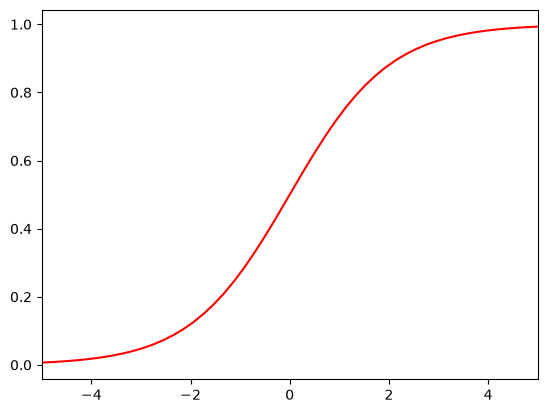
The sigmoid function is very useful for binary classification. Its outputs, which vary between 0 and 1, can be used as the probability of belonging to a certain class. Since the y value of 0.5 (50% probability) happens at x = 0, in a binary partition, one class should be assigned to the left and thg other to right of the y axis.
It’s probably also relevant to note that the sigmoid function is non-linear, which means it can be used as an activation function, allowing neural networks to learn complex patterns.
x = torch.linspace(-5, 5, 50)
y = torch.sigmoid(x)

plt.plot(x, y, 'r-')
plt.xlim([-5, 5])
plt.show()
Training a Neural Network for binary classification
Training a model for binary classification is very similar to training a model for linear regression. I actually just copied the code I used for the linear regression model and modified it slightly (I had to add a sigmoid function as the last activation function of the model).
nn_classifier = nn.Sequential(
    nn.Linear(2, 1),
    nn.ReLU(),
    nn.Linear(1, 1),
    nn.Sigmoid()
)
The training loop looks the same as before.
for epoch in range(training_epochs):
    # forward pass
    y_hat = nn_classifier(data)

    # loss function
    loss = loss_func(y_hat, labels)
    losses[epoch] = loss

    # backprop
    optimizer.zero_grad()
    loss.backward()
    optimizer.step()
The model output looks like this. Not bad at all.
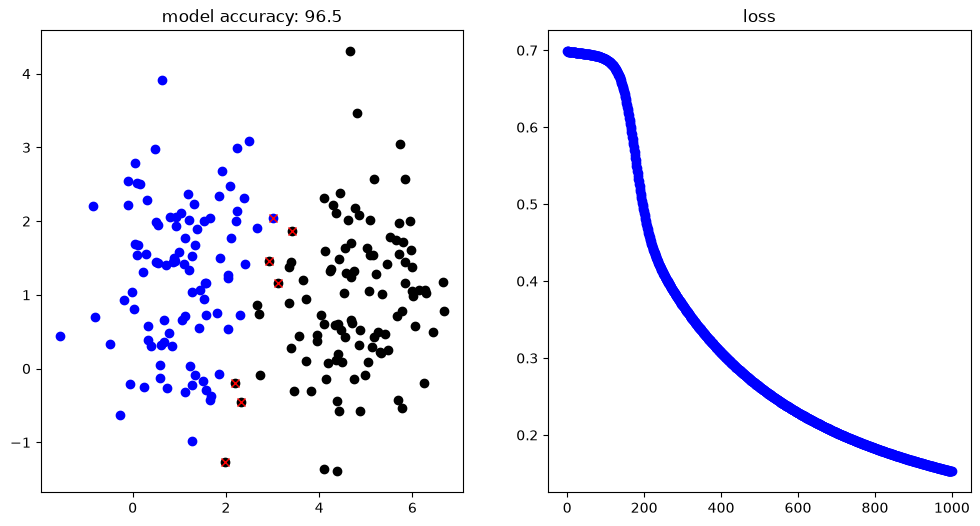
But there is one problem: if you run this exact model multiple times, you’ll notice it produces very inconsistent results. Sometimes, it plateus at 50% accuracy (basically just guessing) and, sometimes, it plateus at 90% accuracy.
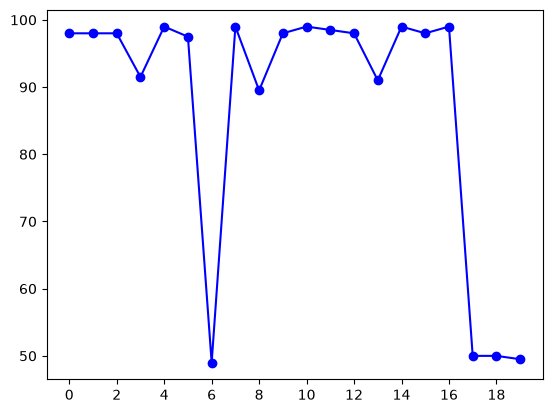
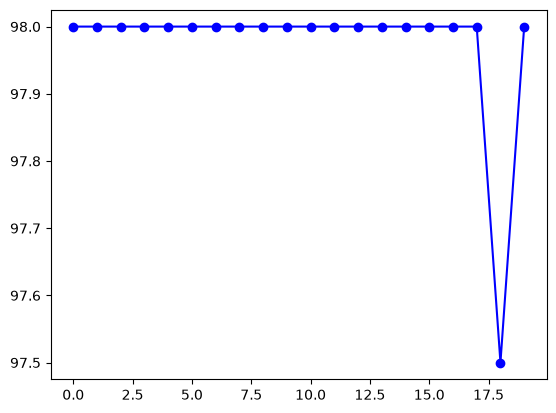
This happens because of the ReLU function, which is used as the activation function for the first layer of the model. If the results of the first linear function are < 0, ReLU will always output 0. This can confuse the model. Removing this function instantly improves model consistency.
nn_classifier = nn.Sequential(
        nn.Linear(2,1),
        #nn.ReLU(),
        nn.Linear(1, 1),
        nn.Sigmoid()
    )